Sunday, April 3, 2011

Living in Playóna


The beginning of February marked moving into my own house.  There was a lot of back and forth in the community about building a new house or taking on an existing house and renovating it.  I pushed for moving into the existing house simply because it would mean cutting down less trees of the rainforest.  I moved into a house that was built for a teacher who is no longer working in the town.  The roof needs to be fixed and we are going to make the living room bigger. 

My djaba Bansi and I went into the jungle to cut penca leaves for the roof, which was a lot of fun, but really tough.  We walked around looking for the leaves, cutting them down with machetes, folding them up and walking a wrapped pile back to the village.  Some of the leaves are hard to reach and required Bansi to climb the trees to chop them down.  After Bansi climbed the tree, I stuck his machete on a large stick to hoist it up to him.  He cut and I organized the pile.  Walking out of the jungle with 20 penca leaves on your back is heavy. 

I also learned how to use a chainsaw.  Harder than it looks, but I'm practicing.
Can you find Bansi up in the tree?

Tieing penca leaves into a 'bulta', Emberá style
After having such a good time with my host families in December and January, I almost stayed with them for the rest of my service.  Although that would have been great, it would have detracted from my work and personal experience.  The more people I talk to and create relationships with, helps me in the Environmental Health work I’m trying to do.  Continuing to live with host families for 2 years would have isolated me from the community.  I’m always at their houses anyway - as they insist on continuing to feed me, I insist on eating.

Personally, life is simply more real in Alto Playón living alone. I cook, clean, do my dishes, and carry water from the river (I have a lot of respect for the women who carry 5 gallons of water (40 lbs.) on their head for 4 times a day everyday).  It’s unusual to not get gifted some platano, rice, or ñame from someone’s farm.  I’m on my own schedule as well.  I’m usually up at 5:30, bathe, meditate, cook breakfast, and start the day.  Having my own house makes me more of a community member and not just a guest.

There’s still a lot of work to do:  fixing the roof, building a latrine, working on the extension, rainwater catchment, and connecting to the aqueduct.  Life moves at a different pace in Playona, but it’s good to be living there.

My house during sunset.  We're opening it up

View from behind my house.  Chucunaque River in the background.

Saturday, February 5, 2011

Participatory Community Analysis

Within the first three months, Peace Corps volunteers are also trained to conduct a Participatory Community Analysis with community members. The activities that I felt were appropriate to introduce into Alto Playón were a Community Map, Seasonal Calendar, and a Needs Matrix. The goal of these activities is for them to analyze their community, talk about the current problems, and ways to solve them. These are tools aren’t just information gathering. They can move communities to action and break the cycle of paternalism at exists in much of the developing world.

I met with various community members to explain them the activities so that they could be facilitators for the various groups: men, women, and young men. Drawing out little pictures of what the activities would look like helped them grasp the concept a little bit more. It took a lot of confidence building for them to become facilitators, which is part of this process. This sets the tone for my work here, that every activity or project that we do will be co-facilitated by community members.

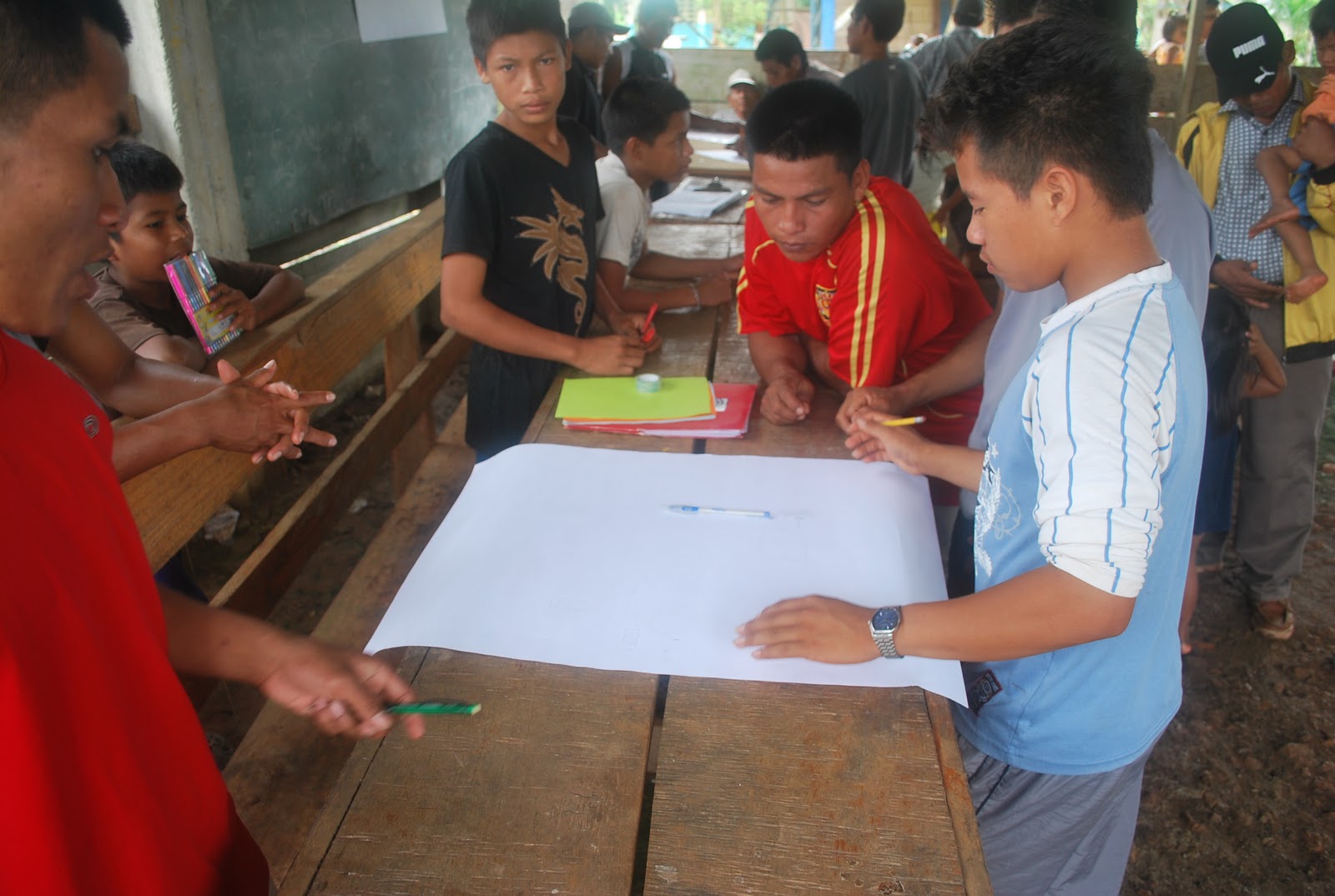
Community Mapping Exercise

I set up 3 tables in the Casa Comunal for each group to work. It took a while for us to get started. Luckily, my co-facilitators came through and other community members stepped up to the task as well. Instead of only 3 maps, we came up with 5!  Each group then presented their maps to the rest of the community, and I wrote down all of their ideas.


Young Men's group presenting

Women's group sharing their map

Young Men's group sharing their map

Alfonso explaining the activity to community members after we finished

This really helped them understand the point of the activity, and they started asking me questions as to what to do next to achieve their ideas. I was able to explain to them my role even further, that I can’t bring these projects to them. Once a community is organized, we can work together to formulate a project plan and solicit funds for it. Other members of the community then stood up and started talking about how I could be resource to the community, even calling me a ‘facilitator.’ Three days later the community held a meeting and started it’s first Health Committee. In the next 2 years, these will be the people that I work with.

Seasonal Calendar

The Seasonal Calendar exercise is a tool that helps community members look at their lives on an annual basis. It can be used to track fluctuations in labor patterns, health patters, income, etc. I spoke with the same facilitators that I used for the community map to ask them if/how this tool could be of use to them. My community counterpart, Esterio, mentioned that he could use this to understand all the products that are farmed in the community, and when the different plagues come that hurt their crops. I asked Ana, his daughter, to facilitate a calendar that maps out all of the diseases that come to the pueblo and when. The women were also able to use the calendar to plan out an artistan business and a bird raising business.

The activity went well, and it highlighted the need in the community for a group of farmers to get together to solicit ways that they can protect their crops from the plague that comes. It is possible for me to work with Sustainable Agriculture volunteers on helping them increase their rice yield, and this is good information to have.


My 2 host dads who are great


Most interest to me was the women’s presentation about illnesses. They talked about diarrhea, vomiting, various skin infections, and malaria. I plan on using this information with the Health Committee to say that these are the illnesses we have here, explain what they are and where they come from, and what we can do to prevent them.

Community Integration


The first 3 months of Peace Corps service is dedicated to community integration.  It’s important for me and my community members to feel comfortable with each other before starting to do any kind of Environmental Health Work.  What has helped me relate most to my community members is to share their food, use body language, exchanging English and Emberá, and always taking up an invitation. 

Food is nothing short of an ambassador in cross cultural integration.  When community members see that I enjoy their food, it makes them happy that I am enjoying the same things that they enjoy.  Furthermore, the food that I eat is fresh from the river or the jungle and absolutely delicious!  I was a vegetarian before I came to the Peace Corps.  However, I've made the decision that when I am in site that I will accept any plate of food that is given to me.  How can I turn down a plate of food from a host family, that on a whim - invited me to live with them for a month?  I don't look at this as defaulting on my values as a vegetarian, but rather being humbled by the family that wants to share their food with me. 

Not only do we share the same food, the time spent together before eating is also important.  When I enter a house, they immediately offer me a chair, which I take.  As the conversation progresses, I eventually move to the floor and stretch out.  I try to use my body language as a way of letting them know that I feel comfortable in their house, which lets them feel comfortable with me. 

Learning Emberá has been a lot of fun in site.  I have been learning the words that I would use most often in a day:  how are you, where are you going, how did you sleep, I'm going to bathe, this is delicious, etc.  They always laugh and get excited after we finish a short exchange in Emberá.  Everyone in site asks me to learn English.  I was hesitant at first, because I didn't want to be seen as an English teacher.  But then I realized that English was something that they wanted to learn about me, the same way I want to learn about them.  This led me to visit houses and offer to speak English, which has always been a hit.  I will say that they are more interested about my work and me afterwards, simply because we had fun together.

Being invited to anything by anyone is an opportunity to integrate, have fun, and get to know my community members.  When I show interest in what they are doing, they are excited that I am there.  From going to an activity at the school, going hunting, harvesting platano, going to church, gutting various animals, or bathing someone's daughter in the river, these are all ways for us to feel comfortable with each other.  There have been days when I get invited for 2 breakfasts, come back from working in the fields only to leave again with someone else.  I never say no to anything. If they ask me to bring my camera, I let them use it.  Most of the times that I'm out in the pueblo or in the finca, I have 10 people laughing at me.  Of course I can't throw machete, row a piragua, or wash my clothes like they can!  It's a great way for them to teach me something.

Now that the first 3 months are over, it doesn’t mean that I’m integrated, this something that I will be working on for the next 2 years. What we have achieved over the last 3 months however, is a new way of understanding each other. 


Game on Nov. 3rd - Panamá Independence Day

Pulling the piragua into the jungle

Wading through the jungle


Helicopter lands to deliver food sacks from the government

Rice field

This is the first Casicque General of the Comarcá Emberá-Wounaan.  He is responsible for starting the Comarcá in the 1970's.  Quite an achievement for someone with no formal education. 

Flooding in early December was the highest that the community had ever seen - ever.

Humanitarian aid from the Red Cross


Artistan crafts


Playing Chi-bom-bom on New Year's Day