Saturday, October 2, 2010

Pueblo Nuevo

We had a 9 day Field Based Technical training at a volunteers site called Pueblo Nuevo.  The site is located in the Darien region and is a village of the Embera and Wounaan tribes that spreads cross eastern Panama and northern Colombia.  Most of the campesinos in Pueblo Nuevo have crossed over from Colombia and settled in Panama - it was all one land at one point however.  I stayed with a host family who were extremelly warm and welcoming.  I instantly became a source of excitement for my 12 year old brother and my cousin.  Every night we would play English language word games and one night there were about 6 kids at the house playing.

Unfortunately I arrived a day late because I came down with chronic dehydration - but really I was fine.  I also came down with an alleric reaction to the river shrimp that I got served, which amounted to a full blown body rash and inflamation.  I sucked it up and spent another day traveling between the Darien and Panama City to go see the doctor who cleared me out.  It was annoying, but I was fine. 

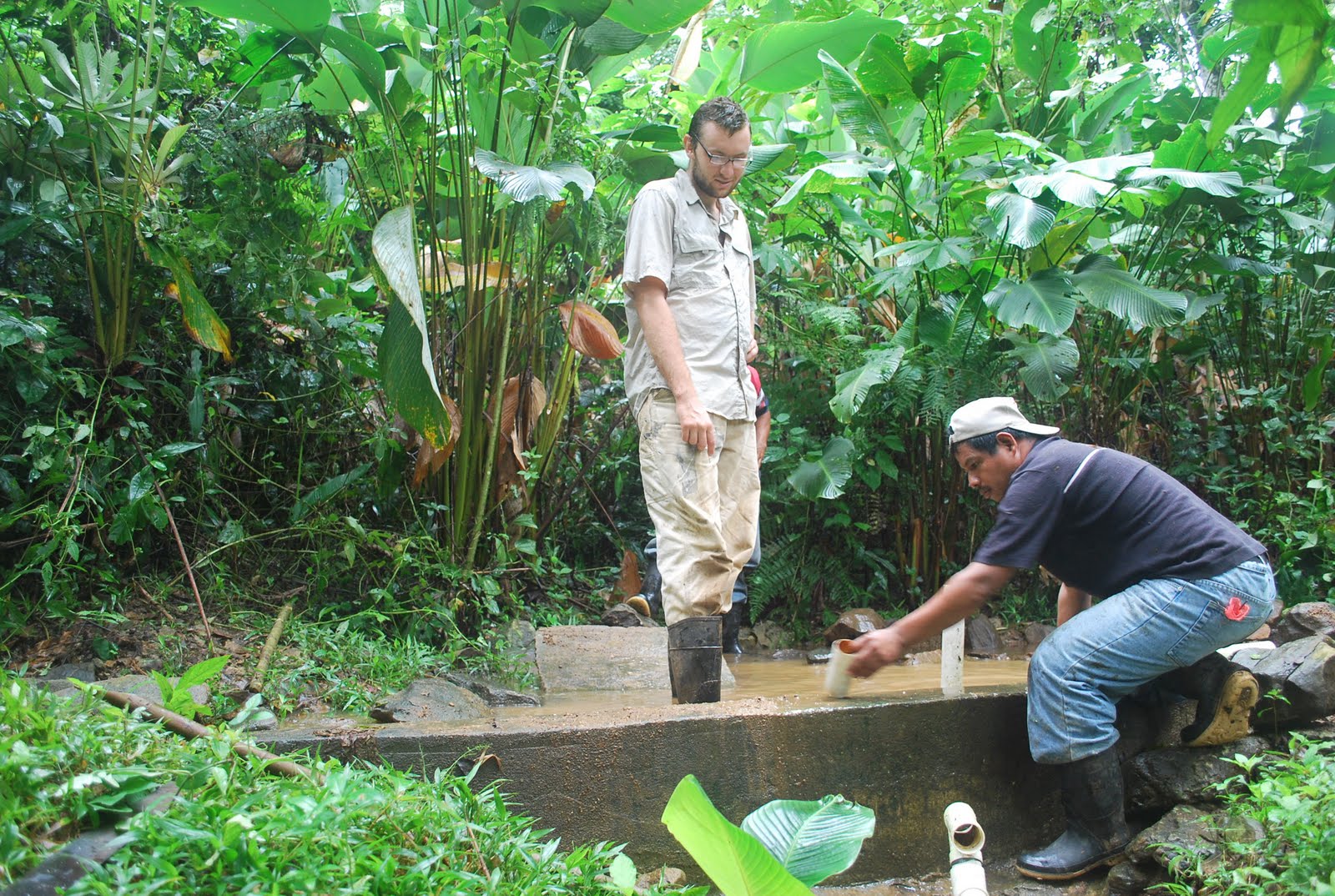
Anyway, we were split up into two groups and our tasks were to build a composting latrine, a pit latrine, hook up a tapstand to the existing waterline, build a bridge for a pipe to cross a very small ravine, learn how to survey, and deliver a charla to the kids at the school.  I will get into the technical aspects of Environmental Health work in another post.  It was a lot of hard work, but we accomplished all the tasks together as a team. 

We were working from 8 to 5 everyday, and the women of the village would cook us a communal lunch everyday.  The best food I ate however, were the coconut duros.  Duros are homemade frozen juices which are delicious at the very affordable price of 10 cents.  My host mom also made a delicious type of bread called ohaldra which thankfully can be found all over Panama.  Imagine the fried bread that is in funnel cake, but without any of the sweet stuff and a bit saltier.  Combine that with huevos and some ketchup and youve got yourself a delicious meal.

Life in the village seemed to be paced around the kids coming in and out of school.  I would say that there was about a 65 percent to 35 percent ratio of kids to adults.  The women in the community got together and hired a teacher to help them make traditional Embera Wounaan baskets and jewlery which they can then sell.  The men would go out to the monte everyday and work in the fields.  Unfortunately I didnt have time to go out with my host dad, but there will be plenty more of that to come.  It is possible for campesinos in the Darien to make 10 dollars a day.

We were all lucky enough to be body painted with traditional Embera Wounaan designs using a fruit called Jagua.  It turns out to be a bluish color and lasts for about 3 weeks.  Pueblo Nuevo was so excited to have us visit and work in their community that we had a despedida the last night we were there.  It was a humbling experience for all of us to be given gifts.  I recieved a necklace, a bracelet, and my host mom hand wove me a basket the night before I left. 

Thank you to Molly Peterson and the people of Pueblo Nuevo for hosting us.  I hope to visit you again soon.

Embera Wounaan dance.  My host mom is in the middle


Jagua

We hiked to the small waterfall which is the source of the towns water


Host brother and host cousin


Monday, September 6, 2010

What is Development?

Tough question.

The introductory session we had on this a week ago was one of the best lectures I have attended in a long time.  There is a certain approach that the Peace Corps has taken to development which is the foundation of the work we will be doing in Panama.
  • The Peace Corps has no money.  Therefore, volunteers live and work on the same wages of the people in their communities.  This also means that there is no budget that the Peace Corps needs to spend on projects.
  • People and processes, not products and projects.  There is no need for a volunteer to come to a community, build an aquaduct, make sure it works, and then leave.  That has been the case in the development world for the last 50 years.  We are focused on developing capacity of the people who will continue to live the rest of their lives in their community to gain the skills to maintain their systems themselves.
  • Development organization or cross cultural exchange?  With no budget allocated or specific project agenda, a volunteer could spend an entire 2 years not laying a single piece of pipe.  By living alongside people in a community, you get to share your life with theirs.  Any aquaduct, business plan, or tourist center that you build won´t be as valuable unless you also build relationships.
Having sat through this lecture was not only inspiring, but a sigh of relief.  The Peace Corps does a pretty good job of keeping you in the dark of the type of work you will be doing and how you will be doing it.  If it were not for speaking with returned volunteers, I wouldn´t have had a sense of these concepts straight from the website or any recruiters.  The approach that the Peace Corps undertakes worldwide is unique and should be its main advertising strategy.

At the end of a conference held by the Peace Corps in Panama, Roland Bunch answered the question with 5 words:  Development is love in action.

La Pedregoza

I visited another Environmental Health volunteer for the last 5 days and the trip was excellant.  Aaron lives in a small mountaintop community called La Pedregoza, which is outside Penonome the capital of Cocle province.  The community was founded in the 1960s by a priest who wanted to start a community of people who are willing to live and work together while following their faith.  Aaron learned that the pioneer spirit still exists in Panama.  As the Inter-Americana grows closer through the Darien (the region that is close to the Colombian boarder), Panamanians spread out and farm the land.

Aaron is working on an aquaduct project for his community, and is following up from the work of a previous PCV.  The PCV built and connected 2 tomas.  Tomas are concrete boxes of various designs, depending on the terrain, which collect the water from the spring and filter it through the use of packed bedrock.  Pipework is then connected out of the spring and routed to the community.  Currently, about 50% of La Pedregoza is seved by this system and have running water at their homes.  Previously, the community would go to a well and collect water from there.  In both cases, the water is still untreated. 

Friday was supposed to be a day to clean the toma, which is extremelly dirty from lack of maintenance.  It was about an hour and a half hike up through the mountains and into the forest which allowed for stunning views of the mountains of Cocle, some untouched forest, and even a view of the Pacific Ocean.  Only Aaron and the president of the water committee showed up to work on the toma, which was disappointing, but not unexpected.

Sunday was the big water committee meeting that was held after church.  This is where the water committee presented to the community their plans to expand the water system so that each home would have a tap of clean, running water.  They will work to build another toma to capture water from another spring, build a reservior tank to use water from the dry season, and lay all the pipe.  Aarons role is to facilitate this process, not lead it.  The members of the water committee are keeping track of the work days owed by each family, the dues, and the organizing.

I want to say thank you to Aaron and the people of La Pedregoza for having me as their guest for 5 days.  It was great to see a volunteer in action and I hope to work within my community the same way Aaron does.

Water committee general meeting
Cleaning the toma
Cleaning the toma
Old well, which the community still uses